[vc_row css=”.vc_custom_1647537598059{margin-top: 50px !important;}”][vc_column css=”.vc_custom_1651479662622{margin-top: -30px !important;}”][vc_column_text]
Training IQ
The IQ Mindware brain training system is based on the Octa-g model, a consensus theory developed by Dr. Mark Ashton Smith and many other leading cognitive neuroscientists over a number of decades.

Training IQ
Contemporary theories of psychometric intelligence distinguish between four different functional dimensions of intelligence: Fluid intelligence (reasoning, concept abstraction & creative problem solving), crystallized intelligence (knowledge, skills & strategies or ‘mindware’), working memory (goal directed short term memory and attention control – also known as executive control), and processing speed for efficient, auto-pilot cognition. These are Gf, Gc, Gwm and Gs.
IQ Mindware training is based on:
- Near transfer training for executive function & processing speed
- Far transfer training for fluid reasoning & crystallized intelligence
Near transfer means the cognitive training can be thought of as skill learning – and when real life demands require the same skill that was trained (such as the use of working memory or selective attention), there will be a useful training benefits. Far transfer means that the training benefits extend beyond a given skill to complex cognitive problems more generally – such as you find in a culture-fair IQ test.
General intelligence is the fluid ability to integrate multiple cognitive abilities in the service of solving a novel problem and thereby accumulating crystallized knowledge that, in turn, facilitates further higher-level reasoning.
― WISC-V (Second Edition), 2019
At IQ Mindware, we train both general-purpose cognitive skills such as working memory and attention control, as well as the ability to coordinate and combine those skills in novel, efficient ways to problem solve and learn.
Near Transfer Training Program: Dual N-Back Based
Cognitive Training Gains: Working Memory
Working memory (WM) is a factor of g (IQ). Complex cognitive tasks such as learning, reasoning, and comprehension can be completed only with sufficient capacity to hold information as it is processed while shielding from distraction. WM is the short term memory system for this. It is your ‘mental workspace’ and is limited in capacity.
Individuals differ in their working memory capacity, and WMC strongly predicts other measures of IQ such as fluid reasoning as well as reading comprehension, attention control, and skill learning. WMC is closely related to educational and professional success. (2)
Measurable Benefits: Cognitive Tests
- Improved scores on valid, standardized tests of working memory – both verbal and visuospatial (e.g. the Operational Span test in the G Track app).
- Improved scores on valid standardized tests of short term memory
- Improve scores on the working memory subtest of full scale IQ tests.
Benefits in Daily Life
- Generally improved ability in working memory – for short term memory and updating of information internally while reasoning, comprehending, following instructions, problem solving, decision-making and learning
- Improvements in issues with inattention (11)
- Improvements in emotion regulation (12)
Far Transfer Training Programs for G
Relational Reasoning Training
i3 Mindware combines DNB training with relational reasoning practice. Here is a screenshot of one of the i3 exercises.
Practice with these exercises should be done daily with the DNB training and this practice trains relational reasoning which is critical for general intelligence as measured by culture-fair IQ tests.

Flexible Cognitive Skill Training
The other way IQ Mindware apps train for far transfer is by the 2G+ dual n-back game. After your first 4-6 weeks of training, you can then train using this game that is designed for maximum coordination and integration of core cognitive skills trained in the more basic games.

Training Effectiveness: Evidence
There is the highest level of evidence and consensus among researchers that classic DNB training increases working memory capacity via near transfer skill-acquisition, improving untrained working memory tasks. (3-9) The evidence indicates the training effect is long-term. (9)
“The results are highly consistent: near transfer frequently occurs….the presence of near transfer seems unquestionable.” (3)
The general finding is that the higher the neuroplasticity of a person’s brain (associated with age) the higher the training gain. (3) Training effect sizes are the same as those found for clinical antidepressants such as Fluoxetine in (10). Certainly a lot is invested into developing anti-depressants based on the same magnitude of effect size.
Neuroplasticity Mechanism
Less taxing, automated tasks can be performed within specialised modules in the brain, while more challenging tasks require integration between multiple modules. Brain modularity decreases – and a ‘global workspace’ (13) configuration increases – with greater task demands. Stronger integration is associated with better fluid intelligence (Gf), while stronger segregation helps crystallized intelligence (Gc) and processing speed. When there is a good baseline balance between brain integration and segregation, there is more flexibility in recruiting modules, and switching from modular to integrated states. This is associated with better learning and memory. (14)
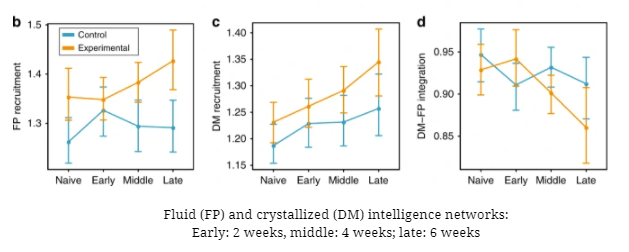
A recent Nature fMRI study (15) reveals that between 4-6 weeks of dual n-back training results in an increase of the fluid intelligence frontoparietal network activation and a decrease of integration between the default-mode (crystallized intelligence) and frontoparietal networks. With 4-6 weeks i3 Mindware DNB training, 5-6 days a week, half an hour a day, there is increasing automatisation of the 2-back working memory skill and more modular network organisation with less costly ‘global workspace’ network integration. This kind of effect follows the pattern of other types of skill acquisition. Demanding working memory tasks becomes more modular, automatic and effortless, while even higher level tasks can then be learned. These neuroplasticity effects are shown in the figures here (15):

Relational Reasoning Training
Relational processing and reasoning is critical for fluid intelligence and IQ. (16, 17) Meta-analyses of multiple studies show that relational reasoning training transfers to culture fair tests of IQ as well as real-life intelligence gains in educational settings. (18, 19) Meta-analyses have found that (a) the training improved fluid intelligence (IQ), (b) the training effect did not diminish over time, and (c) that it improves learning during classroom lessons at least to the same magnitude as the effect on fluid intelligence.
Moreover, simple practice leads to learning effects that improve scores on culture fair IQ tests. (20)
References
- Jaeggi, S. M., Buschkuehl, M., Jonides, J., & Perrig, W. J. (2008). Improving fluid intelligence with training on working memory. Proceedings of the National Academy of Sciences, 105(19), 6829–6833. https://doi.org/10.1073/pnas.0801268105
- Working Memory—An overview | ScienceDirect Topics. (n.d.). Retrieved 28 March 2022, from https://www.sciencedirect.com/topics/social-sciences/working-memory
- Sala, G., Aksayli, N. D., Tatlidil, K. S., Tatsumi, T., Gondo, Y., & Gobet, F. (2019). Near and Far Transfer in Cognitive Training: A Second-Order Meta-Analysis. Collabra: Psychology, 5(1), 18. https://doi.org/10.1525/collabra.203
- Pappa, K., Biswas, V., Flegal, K. E., Evans, J. J., & Baylan, S. (2020). Working memory updating training promotes plasticity & behavioural gains: A systematic review & meta-analysis. Neuroscience and Biobehavioral Reviews, 118, 209–235. https://doi.org/10.1016/j.neubiorev.2020.07.027
- Stavroulaki, V., Giakoumaki, S. G., & Sidiropoulou, K. (2021). Working memory training effects across the lifespan: Evidence from human and experimental animal studies. Mechanisms of Ageing and Development, 194, 111415. https://doi.org/10.1016/j.mad.2020.111415
- Soveri, A., Antfolk, J., Karlsson, L., Salo, B., & Laine, M. (2017). Working memory training revisited: A multi-level meta-analysis of n-back training studies. Psychonomic Bulletin & Review. https://doi.org/10.3758/s13423-016-1217-0
- Gathercole, S. E., Dunning, D. L., Holmes, J., & Norris, D. (2019). Working memory training involves learning new skills. Journal of Memory and Language, 105, 19–42. https://doi.org/10.1016/j.jml.2018.10.003
- Shahar, N., Pereg, M., Teodorescu, A. R., Moran, R., Karmon-Presser, A., & Meiran, N. (2018). Formation of abstract task representations: Exploring dosage and mechanisms of working memory training effects. Cognition, 181, 151–159. https://doi.org/10.1016/j.cognition.2018.08.007
- Melby-Lervåg, M., & Hulme, C. (2013). Is working memory training effective? A meta-analytic review. Developmental psychology, 49(2), 270–291. https://doi.org/10.1037/a0028228
- Turner, E. H., Matthews, A. M., Linardatos, E., Tell, R. A., & Rosenthal, R. (2008). Selective publication of antidepressant trials and its influence on apparent efficacy. New England Journal of Medicine, 358, 3, 252–260.
- Spencer-Smith, M., & Klingberg, T. (2015). Benefits of a working memory training program for inattention in daily life: a systematic review and meta-analysis. PloS one, 10(3), e0119522. https://doi.org/10.1371/journal.pone.0119522
- Xiu, L., Wu, J., Chang, L., & Zhou, R. (2018). Working memory training improves emotion regulation ability. Scientific Reports, 8(1), 15012. https://doi.org/10.1038/s41598-018-31495-2
- Dehaene, S., Kerszberg, M., & Changeux, J. P. (1998). A neuronal model of a global workspace in effortful cognitive tasks. Proceedings of the National Academy of Sciences of the United States of America, 95(24), 14529–14534. https://doi.org/10.1073/pnas.95.24.14529
- Wang, R., Liu, M., Cheng, X., Wu, Y., Hildebrandt, A. & Zhou, C. (2021). Segregation, integration, and balance of large-scale resting brain networks configure different cognitive abilities. Proceedings of the National Academy of Sciences. 118. https://doi.org/10.1073/pnas.2022288118
- Finc, K., Bonna, K., He, X., Lydon-Staley, D. M., Kühn, S., Duch, W., & Bassett, D. S. (2020). Dynamic reconfiguration of functional brain networks during working memory training. Nature Communications, 11(1), 2435. https://doi.org/10.1038/s41467-020-15631-z
- Jastrzębski, J., Ociepka, M., & Chuderski, A. (2020). Fluid reasoning is equivalent to relation processing. Intelligence, 82, 101489. https://doi.org/10.1016/j.intell.2020.101489
- Alexander, P. A. (2016). Relational thinking and relational reasoning: Harnessing the power of patterning. Npj Science of Learning, 1(1), 1–7. https://doi.org/10.1038/npjscilearn.2016.4
- Guerin, J. M., Wade, S. L., & Mano, Q. R. (2021). Does reasoning training improve fluid reasoning and academic achievement for children and adolescents? A systematic review. Trends in Neuroscience and Education, 23, 100153. https://doi.org/10.1016/j.tine.2021.100153
- Klauer, K. J., & Phye, G. D. (2008). “Inductive reasoning: A training approach”: Erratum. Review of Educational Research, 78(4), 1142. https://doi.org/10.3102/0034654308327416
- Bors, D. A., & Vigneau, F. (2001). The effect of practice on Raven’s Advanced Progressive Matrices. Learning and Individual Differences, 13(4), 291–312. https://doi.org/10.1016/S1041-6080(03)00015-3
[/vc_column_text][/vc_column][/vc_row]
 English